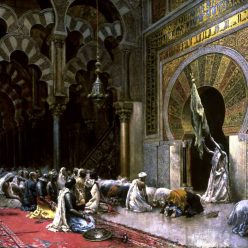
Fashion and faith meet, on foreheads of the pious

CAIRO:Â There is a strong undercurrent of competition in Egypt these days, an unstated contest among people eager to prove just how religious they are. The field of battle is the street and the focus tends to be on appearance, as opposed to conviction.
It is not that the two are mutually exclusive, but they are not necessarily linked. As Egyptians increasingly emphasize Islam as the cornerstone of identity, there has been a growing emphasis on public displays of piety.
For women, that has rapidly translated into the nearly universal adoption of the hijab, a scarf fitted over the hair and ears and wrapped around the neck. For men, it is more and more popular to have a zebibah.
The zebibah, Arabic for raisin, is a dark circle of callused skin, or in some cases a protruding bump, between the hairline and the eyebrows. It emerges on the spot where worshipers press their foreheads into the ground during their daily prayers.
Continued at bottom of the page…
“That’s why the Christians have something called baptism. They put the child in water, and he becomes a Christian. So what was he originally? A Muslim.”

“As the Prophet Muhammad said, everybody is born Muslim, and their parents convert them to Judaism, to Christianity, or to Zoroastrianism.”
Yes, he really did say that: “No child is born but has the Islamic Faith, but its parents turn it into a Jew or a Christian” (Bukhari, volume 8, book 77, number 597).
It may sometimes look like a painful wound, but in Egypt it is worn proudly, the way American professionals in the 1980s felt good about the dark circles under their eyes as a sign of long work hours and little sleep.
Two decades ago, Egypt was a Muslim country with a relatively secular style. Nationalism and Arabism had alternated places as the main element of identity. But today, Egypt, like much of the Arab Middle East, is experiencing the rise of Islam as the ideology of the day.
With that, religious symbols have become the fashion.
“The zebibah is a way to show how important religion is for us,” said Muhammad al-Bikali, a hairstylist in Cairo, in an interview last month. Bikali had a well-trimmed mustache and an ever-so-subtle brown spot just beneath his hairline. “It shows how religious we are. It is a mark from God.”
Â

Â
Observant Muslims pray five times a day. Each prayer involves kneeling and touching one’s forehead and nose to the ground. All five prayers require placing one’s head on the ground for a total of 34 times, though many people add prayers and with them, more chances to press their heads to the ground. Some people say the bump is the inevitable result of so many prayers — and that is often the point: The person with the mark is broadcasting his observance, his adherence to one of the five pillars of Islam.
But the zebibah is primarily a phenomenon of Egypt. Muslim men pray throughout the Arab world. Indeed, Egyptian women pray, but few of them end up with a prayer bump. So why do so many Egyptian men press so hard when they pray?
“If we just take it for what it is, then it means that people are praying a lot,” said Gamal al-Ghitani, editor in chief of the newspaper Akhbar El Yom. “But there is a kind of statement in it. Sometimes as a personal statement to announce that he is a conservative Muslim and sometimes as a way of outbidding others by showing them that he is more religious or to say that they should be like him.”
There are many reasons for the Islamic revival that has swept Egypt and the Middle East, from the rise of satellite television, which offers 24 hours of religious programming, to economies that offer little hope of improving people’s lives, to the resentment of Western meddling in the Middle East.
But there is also peer pressure, a powerful force in a society where conformity and tradition are aspired to and rewarded.
“I will learn more about someone when I get to know him, but the appearance is the first impression,” said Khaled Ashry, 37, a security guard at a private school.
Hanaa el-Guindy, 21, an art student in Cairo, covers her head and wears a long loose-fitting dress to hide her figure. “The outward appearance is important,” Guindy said. “It says, ‘I am a good person.’ This is a good thing. On Judgment Day, this sign, the zebibah on their forehead, will shine. It will say, ‘God is great.'”
In much of the Arab world, symbols of extreme observance are fairly standard and tend to stem from the conservative religious cultures of Gulf nations, like Saudi Arabia. There is the long beard. In extreme cases men wear a loose-fitting robe that stops at their ankles, just as the prophet Muhammad wore his own gown at ankle length.
Those symbols have seeped their way into Egypt, and are growing in popularity. More and more women, for example, are covering their faces with a niqab, a black mask of cloth that has come to Egypt from the Gulf. The zebibah, however, is 100 percent Egyptian, and does not carry the negative connotation of imported symbols.
Men with long beards can still find it hard to get a job. The zebibah, on the other hand, can open doors. “The zebibah can help,” said Ahmed Mohsen, 35, a messenger for a law firm whose own mark was pinkish, bumpy and peeling. “It can lead to a kind of initial acceptance between people.”
There are no statistics on the zebibah’s prevalence. But today, perhaps more than any other time in recent history, Egyptians are eager to demonstrate to one another just how religious they are.
“In Egypt, it’s the way we pray; we probably hit our heads harder than most in order to get one,” said Ahmed Fathallah, 19, as he played dominoes one evening in a Cairo coffee shop. “You also have to understand that people here like to show off their piety, maybe almost more than in the rest of the Middle East.”
There are many rumors about men who use irritants, like sandpaper, to darken the callus. There may be no truth to the rumors, but the rumors themselves indicate how fashionable the mark has become.
Not everyone has a zebibah. Plenty of Egyptians still regard their faith as a personal matter. But the pressure is growing, as religion becomes the focus of individual identity, and the most easily accessible source of pride and dignity for all social and economic classes.
“You pray, but it doesn’t come out,” said Muhammad Hojri, 23, as he gently teased his brother, Mahmoud, 21, recently while they worked in a family kebab restaurant. Muhammad has a mark. Mahmoud does not, and did not appreciate his brother’s ribbing.
“I pray for God, not for this thing on my forehead,” Mahmoud shot back.
* The zebibah, Arabic for raisin …
… is not the mark of the beast, but is part of a conditioning process that will lead to people
accepting it in the right hand or forehead when the time comes.
“As the Prophet Muhammad said, everybody is born Muslim, and their parents convert them to Judaism, to Christianity, or to Zoroastrianism.â€
As Jesus Christ, the Son of God said to Nicodemus, “Most assuredly, I say to you, unless one
is born again, he cannot see the kingdom of God.†(John 3:3)
… which rules out muslims, unless they accept Jesus Christ as saviour and Lord, and then
they are no longer muslims, but saints.
The zebibah makes a pious muzz look like every other butthead out there. “My, what a fine zebibah you have there Hajj. Oh, BTW, you have some toilet paper hanging from your headrag.”
I can think of a mark that would look better..measuring about 7.62mm in diameter.
Humans can be so silly!