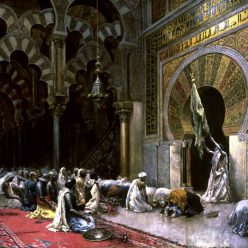
The Shīʿa Rāfiḍah are Despised by Their Sunny Neighbours
Iran has expanded its retaliation across the Middle East, striking embassies, ports, military installations, and threatening global energy routes. Meanwhile, Lebanon’s health ministry said Israeli strikes on two towns south of Beirut killed six people and wounded eight.
Australia has long thrived within the protective orbit of two of history’s most benign empires: first the British, and then, with some hesitation, the American. But the inherent risk of any empire is the quality of its stewards. History reveals that at critical junctures, the ‘experts’ who rule us are too often seized by a collective insanity – a pathological urge to betray their most loyal allies in favour of their most ideological enemies.
When we look at Iran, once the West’s greatest sentinel in the Middle East, we must ask: how was it that the creation of a ruling clique of evil, seventh-century, bloodthirsty mullahs was actually decided by the very men entrusted with Western security?
The Church Militant and the Battle of Lepanto, 1571-2021
By Andrew Harrod
“The Christian victory of Lepanto on October 7, 1571,” a “triumph…still today is a symbol of the militant spirit that should never leave the Christian,” writes Catholic Auxiliary Bishop of Astana (Kazakhstan) Athanasius Schneider in a recent book preface. He thus thematically introduces the excellent new book by leading Italian Catholic historian Roberto de Mattei, Saint Pius V: The Legendary Pope Who Excommunicated Queen Elizabeth I, Standardized the Mass, and Defeated the Ottoman Empire.
Schneider notes that 2021 is the 450th anniversary of this decisive defeat of the Turkish Ottoman Empire fleet off Greece’s western coast by the Holy League’s combined Christian naval force “closely tied to the name of St. Pius V.” Michele Ghislieri, whose brief but tumultuous papacy as Pius V lasted from 1566-1572, “was the true author of the Holy League” in 1571 among the Vatican, Spain’s King Phillip II, and the Venetian Repulic, notes Mattei. “It is not by chance that the Church on earth is called the Church Militant, inseparably united in the communion of saints with the Church Triumphant that rejoices eternally in Paradise,” thus observes Schneider. “St. Pius V offers us a luminous example of this militancy.”
Related History: the Siege of Vienna
The largest cavalry charge in history thundered down a mountainside with 20,000 horsemen. What happened next saved Western civilization.
The Ottoman Empire had laid siege to Vienna for two months, with over 150,000 troops surrounding the city’s crumbling walls. Inside, fewer than 15,000 exhausted defenders faced starvation and imminent defeat. Europe’s heartland stood on the brink of Ottoman conquest.
King John III Sobieski arrived with a relief force of 70,000 men from the Holy League. After surveying the battlefield from the Kahlenberg heights, he made a bold decision. Rather than a cautious approach, he would unleash the full might of his cavalry in one devastating strike.
At around 5 PM, the charge began. Polish Winged Hussars, German cavalry, and Austrian forces formed the largest cavalry charge ever recorded. The distinctive wings attached to their armor created a terrifying sound as they descended. The Ottoman lines, already engaged in fierce fighting, suddenly faced an avalanche of steel and horsepower crashing into their flank.
The charge shattered the Ottoman army within hours. Grand Vizier Kara Mustafa fled, leaving behind treasure, supplies, and 20,000 casualties. Vienna was saved, marking the beginning of Ottoman decline in Europe. Sobieski famously wrote to the Pope afterward, ‘We came, we saw, God conquered.’
The bags of coffee beans abandoned by the Ottomans would spark Vienna’s famous coffeehouse culture.