
Covid is a deadly pandemic. It killed science, logic, evidence-based medicine, and common sense.
But the vax itself is bad news too.
Another ‘Vaccine’ Side Effect: Cancerous Tumors at Injection Site

“Now doctors are saying that COVID-19 vaccines cause cancer, and not just at the site of injection, but throughout the body due to toxic spike proteins that travel to cleansing organs.”
According to pediatricians, military, and veterinarians, it is not uncommon for sarcoma tumors to develop at the injection site of a vaccine, in both humans and pets, whether the injection is in the shoulder, thigh, or elsewhere.
Continued beneath the fold.
This was an actual news header this week:
The CDC has just raised the Monkeypox alert level to Level 2. They’re now also recommending the use of masks to slow the spread… yes, masks. No, I am not kidding about the masks.
Joining the dots:


https://twitter.com/mizteamai/status/1534602000792363008
As Natural News reports, normal cell growth is disrupted by deadly toxins used in manufacturing vaccines, including genetically engineered viruses, engineered bacteria, and various toxic additives and emulsifiers used to stimulate immune responses. These cancerous lesions would have roots that grow in depth over time, making it more difficult for surgeons to remove them safely. –
These sarcoma cancerous tumors occur in connective tissues (usually muscles) and can metastasize over time (called fibro-sarcomas). They begin at the site of the vaccine injection, as the body tries to encapsulate the toxic contents of the vaccine by surrounding them with calcium, in an attempt to prevent further damage that would occur from the toxins and the cancer spreading.
Many carcinogenic vaccine ingredients, as listed on The Centers for Disease Control and Prevention (CDC) vaccine excipient table, include but are not limited to aluminum, mercury, recombinant human albumin, formaldehyde, industrial-based dyes, urea (animal urine), polysorbate 80, bovine albumin, infected African green monkey kidney cells, latex, etc. However, the list of side effects on the packaging does not warn of a possible sarcoma at the injection site, nor do the doctors and nurses.
It is unacceptable for doctors and immunologists to claim that the amounts of toxins in the vaccines are not high enough to cause serious problems when malignant sarcoma-like cancerous tumors are being found at the vaccine injection sites, reports Natural News.
According to Natural News, this occurs in up to 1 in 1000 patients. Most sarcomas would develop after three months, but some had been observed, tested, diagnosed (by biopsy), and registered just a few weeks after the injection. It’s not “abnormal tissue” or inflammation; it’s cancer.
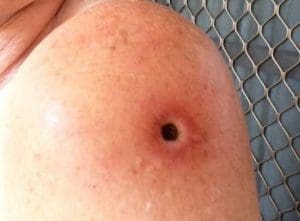
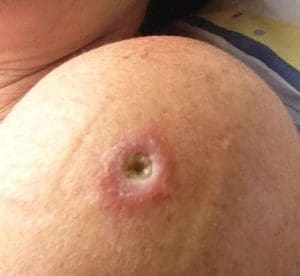
Depending on the depth and location of the tumor, amputation of tissue or even an entire limb may be necessary. Doctors have explained that sarcomas “tend to return to their original site,” requiring aggressive surgery to save lives after vaccination. Below are two images of cancer developing at the injection site.
-
-
Cancer Spreading Throughout Body
“Now doctors are saying that COVID-19 vaccines cause cancer, and not just at the site of injection, but throughout the body due to toxic spike proteins that travel to cleansing organs,” warns Natural News.
As reported at RAIR Foundation USA, Dr. Ryan Cole has warned that the corona vaccines are ineffective and responsible for the increased number of cancer cases.
After Dr. Cole spoke out about the risks of the covid vaccine, ‘numerous’ oncologists contacted him. The doctors reported they are “seeing the weirdest cancers, and cancers that we have been able to keep in check and treat, taking off like wildfire – going stage 2, stage 3, stage 4, just like that.”
“That’s because of the immune dysregulation these shots cause,” emphasized Dr. Cole. An immune system that becomes compromised cannot keep in check cancer growth.
Dr. Roger Hodkinson has warned of the resurgence of cancers previously under control and the emergence of new aggressive cancers after the Covid vaccines. In addition, a research study (by former RAIR Foundation USA interviewees Massachusetts Institute of Technology [MIT] scientist Stephanie Seneff and co-authored by Texas Internist and Cardiologist Peter McCullough, MD and others) found a potential cancer risk associated with the mRNA “vaccine.”
Oh, so THAT’S why they finally released the real cancer cure!
https://www.wnd.com/2022/06/small-nyc-cancer-trial-concludes-unprecedented-results-complete-remission-participants
GOOD NEWS!
U.S. cancer trial concludes with unprecedented results, complete remission for all participants
Jack Davis, The Western Journal By Jack Davis, The Western Journal
Published June 6, 2022 at 10:03pm
A drug trial for rectal cancer patients is attracting attention after all of the patients treated have no detectable trace of cancer.
A report on the study in the New England Journal of Medicine
https://www.nejm.org/doi/10.1056/NEJMoa2201445
… said that a “total of 12 patients have completed treatment with dostarlimab and have undergone at least 6 months of follow-up.”
All 12, it said, have “no evidence of tumor” in a wide variety of tests.
Standard treatment for rectal cancer
https://www.westernjournal.com/athlete-discovers-tiny-dots-skin-sign-deadly-cancer/
… involves either surgery or chemotherapy.
“At the time of this report, no patients had received chemoradiotherapy or undergone surgery, and no cases of progression or recurrence had been reported during follow-up (range, 6 to 25 months),” the report in the Journal said, noting that “longer follow-up is needed” to learn more about the results.
Dr. Luis A. Diaz Jr. of Memorial Sloan Kettering Cancer Center, an author of the study, said he knew of no other study
https://www.westernjournal.com/teacher-moved-hospice-stage-4-cancer-diagnosis-gets-stunning-surprise-students/
… with similar outcomes.
“I believe this is the first time this has happened in the history of cancer,” Diaz said, according to The New York Times.
https://www.nytimes.com/2022/06/05/health/rectal-cancer-checkpoint-inhibitor.html
Dr. Alan P. Venook, a colorectal cancer specialist at the University of California, San Francisco, who had no connection to the study, agreed.
Full remission in all patients tested is “unheard-of,” he said.
“There were a lot of happy tears,” said Dr. Andrea Cercek, an oncologist at Memorial Sloan Kettering Cancer Center and a co-author of the paper.
Venook said the lack of complications from the drug was a surprise, saying “either they did not treat enough patients or, somehow, these cancers are just plain different.”
The drug dostarlimab is part of a group of drugs called checkpoint inhibitors. The drug essentially unmasks cancer cells, so the body’s immune system can then destroy them.
The drug
https://www.westernjournal.com/details-emerge-tennis-legend-announces-cancer-diagnosis/
… was taken every three weeks for six months.
Dr. Hanna K. Sanoff of the University of North Carolina’s Lineberger Comprehensive Cancer Center, called the study “small but compelling” in an editorial published by the Journal.
https://www.nejm.org/doi/full/10.1056/NEJMe2204282
“Very little is known about the duration of time needed to find out whether a clinical complete response to dostarlimab equates to cure,” she wrote.
Dr. Kimmie Ng, a colorectal cancer expert at Harvard Medical School, said the trick now is to have what Ng called “remarkable” and “unprecedented” results to be replicated, the Times reported.
Initially a small biotechnology firm, Tesaro, sponsored the study. That company was purchased by GlaxoSmithKline.