Europe’s Elites Are Coming Round To Victor Orbán’s Way Of Thinking
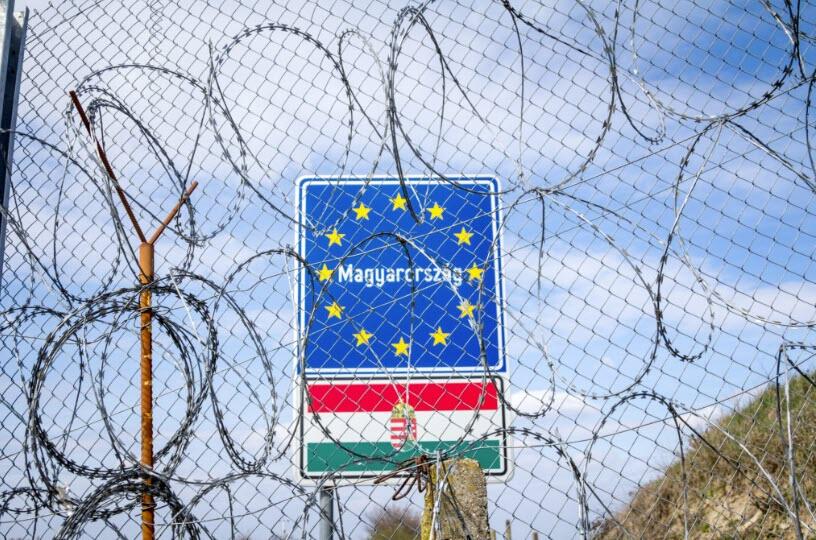
Europe is changing its tune: Now the much-maligned fence on Hungary’s border is becoming an example for all…
Long-term forecasts have been expecting strong winds in Europe for months, and the persistent northerly flow that has long affected the continent has been slowly replaced by southerly and easterly currents, with occasional, yet powerful, westerly gusts. This is expected to continue until the European Parliament elections in the middle of next year and the subsequent power negotiations.
The change in wind direction has just been confirmed by the “chief meteorologist,” Manfred Weber, leader of the European People’s Party parliamentary group. The German politician, who has a keen sense of the current changes, recently said:
“If there is no other way to stop illegal immigration, we must be prepared to build fences.”
Previous blog entry:
ORBAN ANTI WOKE: PM Orbán: 7 steps to reform the EU

Hungarian Prime Minister Viktor Orbán, during a speech given on the occasion of the 30th anniversary of the Soviet troop withdrawal from Hungary, formulated seven theses in which he outlines his vision for reforming the European Union.
In his view, the EU is a political formation created for the economic and military protection of its inhabitants. It was conceived during the Cold War with the hope of healing divisions, and that one day all Europeans will be able to decide about their own future. Despite the noble goals, the reality is that today half of Germans think that they cannot speak freely and are afraid that their opinions could lead to repercussions, especially if they were to speak their minds about topics like Islam, their homeland or patriotism.
Orbán has also quoted former Czech Prime Minister Václav Klaus, according to whom today humanity, family and nationhood are all under a concerted attack, which endangers the future of Europe. In contrasts, Orbán also referred to an earlier comment made by Katarina Barley, vice-president of the European Parliament, according to which “countries such as Poland and Hungary must be starved financially”.
The Hungarian prime minister then went on to outline why he feels that Europe is currently in decline, quoting statistics such as the fact that the EU had produced 25 percent of the world’s GDP in 2008, while in 2018 this was only 18 percent. Orbán sums up his proposals for the EU’s reform in seven points:
1. Instead of a Europe of nations, Brussels is building an imperial European Union, which inevitably leads to a democratic deficit. There is no such thing as a European demos, there are only citizens of nation states, and they are the ones on which European democracies can be built. Democracies based on national identities are now in opposition to empire builders, who are in fact enemies of democracy, claimed Orbán.
2. Brussels is led by those for whom integration is not a goal but a self-interest. This is why they are attempting to overstep traditional values, are attacking families, the idea of nationhood, Christianity, and the Jewish faith. Therefore, it is imperative that Europeans remove the concept of “ever closer union” from the founding documents of the EU at the first possible opportunity.
3. Brussels has outsourced a large chunk of its powers to forces outside Europe, primarily to NGOs tied to United States financier George Soros, and to interests behind the US Democratic Party. This has resulted in the transformation of the European Commission into a political body that busies itself with preparing rule-of-law reports about member states of the EU. However, they have even outsourced the creation of these reports to NGOs active in these countries that are almost without exception tied to the Soros network. It is on the basis of these NGO reports that democratically-elected governments are then assessed, and the ones that are found to be lacking, are often punished.
4. Orbán had brought up several examples in which he demonstrated how the EU has been left behind economically. In his view, without a common European economic success, the union will disintegrate. Hungary will therefore only take part in European political projects that will lead to a common economic success.
5. In the interest of protecting EU member states’ national and constitutional identity, a new institution must be created that involves national constitutional courts.
6. The role of national parliaments must be increased significantly, and based on the example of the European Council’s parliamentary assembly, national representatives should take part in the work of the European Parliament. Parliaments of member states should receive the right to stop EU law-making in case they deem it a threat to national sovereignty, which Orbán named a red card system.
7. Finally, Serbia should be accepted into the EU because it is in the interest of the EU to have them among their members, more so than it would be in the interest of Serbia itself.
Continued
This was not always the case, as eight years ago he took a stand in the name of the “Willkommenskultur” promulgated by Angela Merkel and was so anti-borders that he even invoked “Mutti” (Merkel’s German nickname of “mother”) and directly addressed Donald Trump in a Twitter post in 2017 when he said, “We don’t build walls, we want to build bridges.”
Weber, however, was disappointed with “Mutti” because, despite being the People’s Party’s top candidate in the last European Parliament elections, he was not able to run because Viktor Orbán and Emmanuel Macron, who he often criticized, found someone else better suited to lead the European Commission.
Although the then-crowned Ursula von der Leyen has since been a disappointment, and corruption cases have not been far from her mind, the procedure of four years ago could be instructive for her: She came in first place as an almost unknown running against Weber, who had seemed to be the sure winner. He was lobbying this week for the European People’s Party coalition to include him as its top candidate next year, but it is not enough for him to be acceptable at home because Europe seems to have had enough of Germany dictating the agenda. Meloni’s Italy has already made it clear that it wants to limit migration, and French President Emmanuel Macron has been even more spectacular in his opposition to the German line in recent weeks.
Sometimes critical of the Hungarian prime minister himself, Macron has realized that he has nothing to lose, as the French constitution says he cannot be president for a third time and so far he is only remembered for his yellow vest and pension reform protests, which are hardly a great mark in terms of his place in European history.
In a bid to project a more positive image, he struck an unusually friendly tone with China and then said that Europe should look after its own interests and its leaders should work to create autonomy. German Foreign Minister Annalena Baerbock was the loudest in her protestations; she did not recognize the shifting winds and said there was no place for such dissent in the EU. Macron, however, is not to be so easily swayed and is now going further, joining forces with the Chinese to bring the parties stuck in the quagmire of the Russia-Ukraine war to the negotiating table this year, according to Bloomberg.
All this in a single week:
-
Border fences,
-
the protection of European interests and a ceasefire to prevent the war from escalating are no longer the devil’s work,
-
and after Meloni, Weber, and Macron have now backed Viktor Orbán.
If this continues, by next May, the mainstream will be behind the Hungarian prime minister, who had previously been dismissed by Europe’s elite as anti-human, authoritarian and pro-Putin.