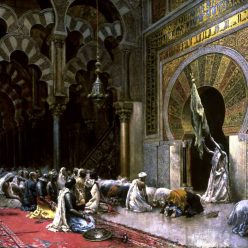

The religious landscape in Japan is witnessing a disruptive and dangerous shift, primarily attributed to the increasing number of migrants from Islamic states and intermarriage between Muslims and Japanese citizens.
The religious landscape in Japan is witnessing a disruptive and dangerous shift, primarily attributed to the increasing number of migrants from Islamic states and intermarriage between Muslims and Japanese citizens. Amidst the burgeoning Muslim population in Japan, a confluence of challenges and tensions emerges, driven by the inherent incompatibility between Islam and the indigenous Shinto religion. With Islam’s unwavering assertion of monotheism, it collides head-on with the polytheistic and animistic fabric of Shinto, erecting formidable barriers to harmonious coexistence. Islam’s unyielding stance dictates the exclusion of any rival source of divinity or religious authority. This tension leaves no room for compromise or accommodation beyond the realm of Mohammad and Allah.
Historical and Cultural Context
Shinto, the indigenous religion of Japan, has deep roots in the country’s folklore, rituals, and animistic beliefs. It is characterized by a reverence for kami, the divine spirits or forces present in nature, and various aspects of life. Unlike Islam, Shinto does not have a specific founder, a single authoritative scripture, or a comprehensive set of doctrines. Instead, it emphasizes purity, gratitude, and living in harmony with the natural world.
Shinto has historically demonstrated an inclination to embrace other religions, including Buddhism. The coexistence of Shinto and Buddhism for over a millennium exemplifies the inclusive nature of Japanese religious practices. However, the compatibility between Shinto and Islam is impossible due to their divergent theological perspectives. Islamic teachings emphasize the oneness of Allah and prohibit the worship of any other entities, which conflicts with the polytheistic nature of Shinto.
Rising Muslim Population and Changing Religious Landscape
Over the past two decades, Japan has witnessed a significant increase in its Muslim population, mainly driven by intermarriage and immigration. Estimates suggest that the number of Muslims in Japan has grown from 10,000 to 20,000 in 2000 to over 200,000 today, a ten-fold increase in less than one generation. This demographic shift has led to the establishment of numerous mosques across the country, which were once a rare sight.
The construction of mosques, such as the Masjid Istiqlal Osaka, funded by donations from Indonesians, highlights the growing presence of Muslims in Japan. However, this growing diversity is beginning to pose the same challenges and friction between Islam and every other religious community in Japan.
Coexistence as equals was something that Islam’s Prophet Muhammad promoted only when he did not have the power to conquer. In the full context of the Quran, ‘peace’ means submission, and ‘tolerance of other religions’ means not killing those members who agree to live in a subjugated status to Islamic rule.
Challenges and Friction
A recent attack in a Shinto shrine by a Muslim migrant highlights the challenges of peaceful coexistence between Islam and Shinto. The incident, caught on camera and shared widely online, resulted in public outcry and raised concerns among Japanese social media users. Unfortunately, the same reckless open-door immigration policy, which has brought a massive wave of crime and jihad attacks to Europe, is now taking shape in Japan.
Most Japanese citizens do not understand that the purpose of Islamic migration, known as hijrah, is to start jihad, and the purpose of jihad is to install Sharia (Islamic Law). As stated in refugee expert Ann Corcoran’s book “Refugee Resettlement and the Hijra to America,” “Hijra remains the model to this day for jihadists who seek to populate and dominate new lands.” To emigrate in the cause of Allah is considered in Islam to be a highly meritorious act.
“I charge you with five of what Allah has charged me with: to assemble, to listen, to obey, to immigrate and to wage Jihad for the sake of Allah” – Quote from the Hadith
With the influx of Islamic migrants into Europe, we witness a resolute determination among Muslims to uphold their religious traditions while exerting their influence on host nations. Their aspirations encompass an array of demands, ranging from the provision of halal food and the establishment of Sharia courts to the exclusion of non-Islamic holidays and curbs on educational practices. Embedded within these demands lies an overarching objective: the metamorphosis of their adopted countries into Islamic enclaves.
The pursuit of these goals by Muslim migrants does not hinge upon resorting to violence. Instead, their migration patterns and prolific birth rates alone have sufficed to reshape Europe’s demographic landscape. The confluence of dwindling populations, labor shortages, the sway of political correctness, and a burden of guilt stemming from colonial history has created a climate where criticism of immigration is stifled.
Regrettably, Europe finds itself hurtling towards cultural oblivion, and it appears that Japan is poised to tread a similar path of self-inflicted cultural decline.
****
Bassam Tibi wirtes in “War and Peace in Islam”:
At its core, Islam is a religious mission to all humanity. Muslims are religiously obliged to disseminate the Islamic faith throughout the world. “We have sent you forth to all mankind” (Q. 34:28). If non-Muslims submit to conversion or subjugation, this call (da’wa) can be pursued peacefully. If they do not, Muslims are obliged to wage war against them. In Islam, peace requires that non-Muslims submit to the call of Islam, either by converting or by accepting the status of a religious minority (dhimmi) and paying the imposed poll tax, jizya. World peace, the final stage of the da’wa, is reached only with the conversion or submission of all mankind to Islam…Muslims believe that expansion through war is not aggression but a fulfillment of the Qur’anic command to spread Islam as a way to peace. The resort to force to disseminate Islam is not war (harb), a word that is used only to describe the use of force by non-Muslims. Islamic wars are not hurub (the plural of harb) but rather futuhat, acts of “opening” the world to Islam and expressing Islamic jihad. Relations between dar al-Islam, the home of peace, and dar al-harb, the world of unbelievers, nevertheless take place in a state of war, according to the Qur’an and to the authoritative commentaries of Islamic jurists. Unbelievers who stand in the way, creating obstacles for the da’wa, are blamed for this state of war, for the da’wa can be pursued peacefully if others submit to it. In other words, those who resist Islam cause wars and are responsible for them. Only when Muslim power is weak is ‘temporary truce’ (hudna) allowed (Islamic jurists differ on the definition of ‘temporary’).