
They stole the election and now they’re stealing the voices of the opposition.
Judge Bans X In Brazil For Refusing To Comply With Demands
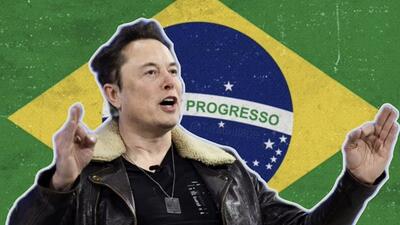
“The tyrant, @Alexandre, is dictator of Brazil. Lula is his lapdog.”
As we previewed overnight, Elon Musk’s X has been ordered ‘immediately suspended’ by Brazilian Supreme Court Judge Alexandre de Moraes, citing the company’s refusal to comply with a legal order to censor the judge’s political opponents, Bloomberg reports.
Officially, the ruling was due to Musk’s refusal to name a legal representative for the social network (after the judge froze his last attorney’s bank accounts).
On Thursday, X’s global government affairs account said that it would “not comply in secret with illegal orders,” and said that it would publish Moraes’ demands and related court documents for transparency.
The Minister of Truth looks exactly like you thought he would

This is the guy who just banned 𝕏 in Brazil

Villain vibes strong with this reprobate.
The attacks this year on free speech are unprecedented in the 21st century.
It will happen in America too if Kamala/Walz gain power.
Just listen to what they’ve said. https://t.co/TkHxCOcs1w
— Elon Musk (@elonmusk) August 30, 2024
How one Brazilian judge could suspend Elon Musk’s X
It’s a showdown between the world’s richest man and a Brazilian Supreme Court justice.
The justice, Alexandre de Moraes, has threatened to suspend social media giant X nationwide if its billionaire owner Elon Musk doesn’t swiftly comply with one of his orders.
Musk has responded with insults, including calling de Moraes a “tyrant” and “a dictator.”
It is the latest chapter in the monthslong feud between the two men over free speech, far-right accounts and misinformation. Many in Brazil are waiting and watching to see if either man will blink.

Brazilian Supreme Court Justice Alexandre de Moraes, has threatened to suspend social media giant X nationwide if its billionaire owner Elon Musk doesn’t swiftly comply with one of his orders. AP
What is the basis for de Moraes’ threat?
Earlier this month, X removed its legal representative from Brazil on the grounds that de Moraes had threatened her with arrest.
On Wednesday night at 8:07 p.m. local time, de Moraes gave the platform 24 hours to appoint a new representative, or face a shutdown until his order is met.
De Moraes’ order is based on Brazilian law requiring foreign companies to have legal representation to operate in the country, according to the Supreme Court’s press office.
This ensures someone can be notified of legal decisions and is qualified to take any requisite action.
X’s refusal to appoint a legal representative would be particularly problematic ahead of Brazil’s October municipal elections, with a churn of fake news expected, said Luca Belli, coordinator of the Technology and Society Center at the Getulio Vargas Foundation, a university in Rio de Janeiro.
Takedown orders are common during campaigns, and not having someone to receive legal notices would make timely compliance impossible.
“Until last week, 10 days ago, there was an office here, so this problem didn’t exist. Now there’s nothing. Look at the example of Telegram: Telegram doesn’t have an office here, it has about 50 employees in the whole world. But it has a legal representative,” Belli, who is also a professor at the university’s law school, told The Associated Press.
Does a single judge really have that much power?
Any Brazilian judge has the authority to enforce compliance with decisions. Such measures can range from lenient actions like fines to more severe penalties, such as suspension, said Carlos Affonso Souza, a lawyer and director of the Institute for Technology and Society, a Rio-based think tank.
Lone Brazilian judges shut down Meta’s WhatsApp, the nation’s most widely used messaging app, several times in 2015 and 2016 due to the company’s refusal to comply with police requests for user data.

In 2022, de Moraes threatened the messaging app Telegram with a nationwide shutdown, arguing it had repeatedly ignored Brazilian authorities’ requests to block profiles and provide information.
He ordered Telegram to appoint a local representative; the company ultimately complied and stayed online.
Affonso Souza added that an individual judge’s ruling to shut down a platform with so many users would likely be assessed at a later date by the Supreme Court’s full bench.
How would de Moraes suspend X?
De Moraes would first notify the nation’s telecommunications regulator, Anatel, who would then instruct operators — including Musk’s own Starlink internet service provider — to suspend users’ access to X.
That includes preventing the resolution of X’s website — the term for conversion of a domain name to an IP address — and blocking access to the IP address of X’s servers from inside Brazilian territory, according to Belli.

Given that operators are aware of the widely publicized standoff and their obligation to comply with an order from de Moraes, plus the fact doing so isn’t complicated, X could be offline in Brazil as early as 12 hours after receiving their instructions, Belli said.
Since X is widely accessed via mobile phones, de Moraes is also likely to notify major app stores to stop offering X in Brazil, said Affonso Souza. Another possible — but highly controversial — step would be prohibiting access with virtual private networks (VPNs) and imposing fines on those who use them to access X, he added.