“On May 29, 1453,” the state-run Turkish broadcaster TRT World
reported happily on Thursday, the 572nd anniversary of the fateful day, “a 21-year-old Sultan Mehmed II led the Ottoman army to a decisive victory over the Byzantine Empire. The conquest of Istanbul remains a shining jewel in the crown of the Ottoman Empire.” Recep Tayyip Erdogan’s desire to restore the lost glory of that empire is well known, but those who are the children and heirs of the victims of its bloody expansion look on this anniversary with somewhat less enthusiasm than TRT World displayed.

In 1453, after more than a thousand years of rule, the Byzantine Empire fell to the Ottoman Turks with the capture of Constantinople. This marked the end of the Eastern Roman Empire and a turning point in world history—closing the medieval era and opening the door to a new age.
For over a thousand years, Constantinople stood as a beacon of faith, wealth, and imperial majesty. Born from the legacy of Rome, the Byzantine Empire outlasted invaders, plagues, and centuries of war. Behind its towering walls and golden domes, emperors ruled a city that was both fortress and jewel of the Christian world.
But by the 15th century, the empire had withered—reduced to the city itself and a few scattered territories. Surrounded by the rising power of the Ottoman Empire, Constantinople stood like a fading star in a darkening sky.
In May 1453, Sultan Mehmed II, just 21 years old, brought an army of over 80,000 men to the gates of the city. For weeks, they bombarded its ancient walls with massive cannons. Inside, Emperor Constantine XI led a vastly outnumbered force—Greeks, Italians, and a few remaining allies—defending the city not just for empire, but for civilization itself.
On May 29, the Ottomans breached the walls.
The city fell.
Constantine XI died fighting, sword in hand, refusing to flee. The Hagia Sophia, once the grandest church in Christendom, became a mosque. The Byzantine Empire—the last echo of Rome—was gone.
But its legacy endured.
Byzantine scholars fled west, carrying classical texts and ideas that would help spark the Renaissance. Its art, law, and Orthodox faith continued to influence Eastern Europe and beyond.
The fall of Constantinople was not just the end of an empire—it was the end of an era, and the beginning of a new world.
Rome’s eastern flame was extinguished—but its embers lit the path forward.

Some Greek Orthodox Christians to this day refer to May 29, 1453, as “the last day of the world.” In a very real sense, that is exactly what it was: the end of over two thousand years of the Roman Empire, the end of what had for centuries been the world’s foremost power and leading Christian state. The conquest of Constantinople meant the eclipse of Christianity in Asia Minor, which had been such an important center of the faith that three of Paul’s New Testament epistles — Galatians, Ephesians, and Colossians — were addressed to Christian congregations there.
Constantinople had been the center of Christianity in the eastern part of the Roman Empire, and the second see in the Church, after only Rome. After the East/West schism of 1054, Constantinople was the heart of Orthodox Christianity. As “
The History of Jihad” recounts in detail, however, on Tuesday, May 29, 1453, the armies of the Ottoman Sultan Mehmet II finally broke through Constantinople’s defenses after a long siege, marking the end of the great Christian Roman Empire.
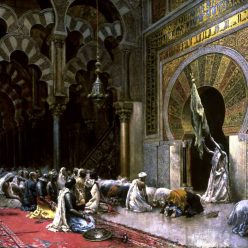
The conquerors were extraordinarily brutal, raiding monasteries and convents, emptying them of their inhabitants, and plundering private houses. They entered Hagia Sophia, which for nearly a thousand years had been the grandest church in Christendom. The faithful had gathered within its hallowed walls to pray during the city’s last agony. The Muslims halted the celebration of
Orthros (morning prayer), while the priests, according to legend, took the sacred vessels and disappeared into the cathedral’s eastern wall, through which they shall return to complete the divine service one day. Muslim men then killed the elderly and weak and led the rest off into slavery.
The Byzantine scholar Bessarion wrote to the Doge of Venice in July 1453, saying that Constantinople had been “sacked by the most inhuman barbarians and the most savage enemies of the Christian faith, by the fiercest of wild beasts. The public treasure has been consumed, private wealth has been destroyed, the temples have been stripped of gold, silver, jewels, the relics of the saints, and other most precious ornaments. Men have been butchered like cattle, women abducted, virgins ravished, and children snatched from the arms of their parents.”
There is more. Read the rest
here.