Lessons learned: zero.
The French are so concerned with “racism”, they’re letting Muslims get away with murder.
Paris is marking the Thursday anniversary with a sequence of tributes led by President Emmanuel Macron and Paris Mayor Anne Hidalgo at each attack site: the Stade de France in Saint-Denis, then the cafés and restaurants in the 10th and 11th arrondissements, and finally the Bataclan, with a minute of silence before each memorial plaque. Parents, partners and friends of victims will stand closest to the plaques, officials said.

At Place de la République, Parisians are leaving candles, flowers and notes at the foot of the statue of national symbol Marianne, as in 2015, and are following the ceremonies on a giant screen. Children are coming with parents to light candles and lay flowers – small, familiar gestures that turn the square into shared memory. City officials have asked the public to keep gatherings calm and give families space at the memorials. On the eve of the anniversary Wednesday, dozens gathered at the same square for a nighttime vigil, where Hidalgo said that “10 years later, the emotion is still intact” and that hope must be shared “despite the pain and the absence.”
The commemorations will culminate with the Jardin du 13-Novembre, a new memorial garden opposite City Hall. Conceived with victims´ associations, it bears the 132 names of those killed on granite stelae, with plantings that echo the attack sites and benches for reflection. Designers added small signs of life – bird baths, nesting boxes, shade – for children at the request of families. The ceremony is scheduled for 6 p.m. and will be attended by Macron and Hidalgo.
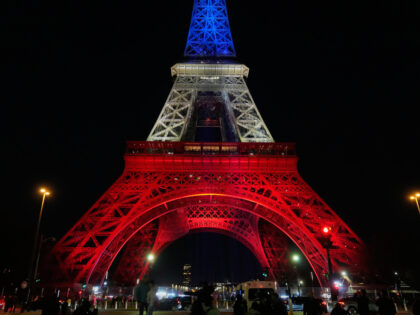
The Eiffel Tower is to be lit again in the colors of the French flag after nightfall, as it was Wednesday night, a silent tribute in the Paris skyline. The French soccer federation will observe a minute of silence and other tributes at France´s World Cup qualifier against Ukraine at the Parc des Princes.
n Nov. 13, 2015 – a Friday – nine Islamic State group gunmen and suicide bombers struck within minutes of one another. Suicide bombers detonated outside the Stade de France; gunmen sprayed bullets across café terraces; and three attackers stormed the Bataclan at 9:47 p.m., killing 90 people before police ended the siege. Two survivors who later died by suicide have since been recognized among the victims.
For survivors, the date reopens wounds.
“The 10th anniversary is here and emotions and tension are everywhere for us survivors,” said Arthur Dénouveaux, who escaped the Bataclan and leads the Life for Paris association. “You never fully heal. You just learn to live differently.”
Many describe a second task after grief: rebuilding the ordinary – work, friendship, noise – without flinching.
A 2021-2022 trial ended with life imprisonment without parole for Salah Abdeslam, the lone surviving assailant, and convictions for 19 others. For many, accountability did not erase the strain of trauma or the daily work of recovery; it clarified what must be protected.
As names are read and wreaths laid, the message from officials and families is consistent: remember the victims, honor the responders, and preserve the ordinary pleasures the attackers meant to destroy.
The goal, planners say, is simple: grief without spectacle, memory with room for the living.
No. We haven’t learned a thing

Today marks the tenth anniversary of a coordinated series of terrorist attacks committed by nine ISIS operatives who, beginning shortly after nine o’clock in the evening, took a total of 137 lives and wounded 416 people in Paris and the nearby suburb of Saint–Denis.
The scheme was ambitious. One group of three gunmen, moving quickly through a neighborhood of restaurants and cafés, mowed down thirteen people on the streets of the tenth arrondissement and inside a Cambodian eatery called La Petit Cambodge, then took five lives on the rue de la Fontaine-au-Roi in the eleventh arrondissement before murdering twenty-one people outside La Belle Équipe, a bar on the rue de Charonne. One of the three gunman, wearing a suicide vest, was then driven to the Comptoir Voltaire café on the boulevard Voltaire, where he sat down, placed an order, and then exploded his vest, injuring fifteen people.
At around the same time, in Saint-Denis, three suicide bombers arrived at the Stade de France, a sports stadium where President Hollande was attending a soccer match between France and Germany. The men intended to gain access to the stadium, but the first of them to try was stopped at security. All three ended up setting off their suicide vests outside the stadium, taking only one life aside from their own.
The third group of three terrorists were more successful. Outside the Bataclan theater on the boulevard Voltaire, they dispatched three people with their Kaloshnikovs before entering the theater, where an American band called Eagles of Death Metal was performing before an audience of approximately 1500. The ISIS members then proceeded to commit a massacre that lasted for two and a half hours. From the Guardian:
…different witnesses described the clear ripple effect of the crowd – “like a gust of wind through wheat” – as people were mown down by gunfire and rows of people dropped to the ground….Witnesses described how their faces were splattered in blood as people beside them were shot in the head and fell. The shooting continued for 10 minutes before the men reloaded and began shooting again, aiming at the head and thorax with professionalism. “It was carnage,” said Marc Coupris, 57, a legal worker. “It looked like a battlefield. There was blood everywhere, there were bodies everywhere.”…
The firing was relentless and indiscriminate….The gunmen fired up into the balconies and dead bodies fell over and down on to the stalls below.….There was lots of screaming, lots of panic, lots of blood. People threw themselves to the ground but then they then just started firing at random at the people on the ground….”
And that was just the beginning. The gunmen laughed as they shot people in the back. They kicked bodies lying on the floor to make sure they were dead. One of the men stood by an emergency exit and picked off victims as they ran towards it. After one gunman exploded his suicide vest, the other two took about a hundred hostages, some of whom they employed as human shields after the police finally arrived; when one of these gunmen, too, detonated his vest, it instantly killed both him and the third gunman. The total number of people murdered at the Bataclan that evening was ninety.
At all of the sites of terrorism that evening, needless to say, there were shouts of “Allahu akbar!”
Fast forward to last Sunday night in Norway. Twenty-two minutes into the evening news at seven o’clock, state-owned NRK-TV – sandwiched between typically mendacious stories about how the Republicans are responsible for the government shutdown in the U.S. and about the incomparable suffering of the innocent inhabitants of Gaza — began a segment commemorating the tenth anniversary of that evening in Paris and environs. I was surprised to see the government channel, which is always at pains to whitewash Islam, even bringing up the memory of Bataclan. But it was soon clear why NRK was doing so.
The segment focused on two survivors of the massacre at Bataclan. One of them, a young man named Thomas, was shot in the hand. Every November 13 he gets together with other survivors of Bataclan. Being a survivor of the atrocity, he says, makes him feel as if he lives in a parallel world. But he doesn’t blame Islam. “Yes, it was carried out by Islamic terrorists,” he says. “But there are extremists who are Catholics and Jesuits. In almost all groups there are some who are more extreme than others.”
Yes, let’s not forget the obscene amount of death and destruction that has been wrought in Europe by Jesuit terrorists.
The other Bataclan survivor was a woman named Gaëlle Messager. Shot in the head and arm, she lost a huge chunk of the left side of her face, including much of her jaw. Surgeons have since reconstructed her face using tissue from her leg. She has undergone no fewer than fifty-six operations and is scheduled to have several more. In fact she will have to keep getting surgery for the rest of her life.
But what does she do when she’s not under the knife? She visits a jihadist in prison.
Yes, that’s right. She talks regularly to a jihadist. She does it partly “as therapy for herself” and partly “to understand how a Muslim extremist thinks.” To be sure, the man whom she visits was not one of the perpetrators of the Bataclan massacre – they’re not available for conversation these days, having blown themselves to bits – but is indeed a believing Muslim and convicted terrorist who is convinced that “a holy war in France is necessary.”
The NRK segment didn’t tell us exactly what the man did to land in prison. But Gaëlle tells us that when she first explained to him why her face looks the way it does, “he was touched.” She had expected, she says, “to meet someone who was totally inhuman. But the meeting had a strong impact on both him and me….He has children and a wife, he has a family.” And she experienced a revelation: “I realized that a jihadist is like everybody else.”
It’s been ten years since Bataclan. And neither of these victims has learned a thing. But why single them out? On November 4, twenty-four years after 9/11, the voters of New York City elected a Muslim mayor who, only days earlier, had praised a terrorist sympathizer as “one of the nation’s foremost Muslim leaders.” In the same way, the London bombings of July 7, 2005, didn’t keep Londoners from electing Sadiq Khan – sorry, Sir Sadiq Khan – and the Westminster Bridge and London Bridge attacks in 2017 didn’t keep him from being re-elected. Twice.
To my mind, it all goes back to George W. Bush. After 9/11, he made a point of defending Islam. He called it a religion of peace. Playing theologian, he said that the Al-Qaeda members who had taken down the World Trade Center had misinterpreted their religion. Everything that has happened since then has flowed from that colossal act of failed leadership by a president who thought he could turn Afghanistan and Iraq into Jeffersonian democracies – but who seemed incognizant of the existential danger that mass Muslim immigration into America represented to our democracy.
If only 9/11 had been the prelude to a comprehensive effort to educate Americans about the reality of Islam, the history of the West during the last quarter century might have been very different. Instead, millions of people in the West have been trained to think of Muslims not as villains but as victims, and to close their minds to any evidence to the contrary. A generation of young Americans and Europeans, born after the Twin Towers fell, have spent their lives being fed messages like the one that Good Morning, Britain host Adil Ray – sorry, Adil Ray, OBE – posted on November 5: “Some say Mamdani may implement Sharia Law. He might. The heart of Sharia is social justice, welfare, fairness, charity and cohesion.”
Yes, some Westerners, young and old, have seen the truth about Islam. But many if not most have been cowed into silence, aware that nothing can destroy their lives more quickly than gaining a reputation as that worst of all things, an Islamophobe. A few heroic politicians like Geert Wilders – who tell the truth and promise to act on it – enjoy considerable voter support, but not enough to give them the power to save their countries from disaster. In any case, those heroes are constantly up against the insidious power of legacy media like NRK – and the BBC, CBC, CNN, the U.S. broadcast networks, and so on – which strive every day to paint Islam as virtuous and its critics as bigots. It’s thanks to those media that the West, after innumerable acts of jihad that have taken an appalling number of innocent lives – and that should have awakened everybody a long time ago – has now reached a point at which a victim of Islamic terrorism can say with a straight face that “a jihadist is like everybody else.” Should we laugh or cry? Should we keep shouting the truth into what can seem like an unanswering void, or shut up and try to enjoy what time we have left before the agents of Allah take power?