Since when did government become parents?
— AUSTRALIAN REPUBLIC NEWS (@AusRepNEWS) December 11, 2025
Australians do not trust their politicians (2019 ANU Study).
Prohibition is a dummy’s solution.https://t.co/9BudfiJfsT
Australia: Always was, Always will be Doublespeak

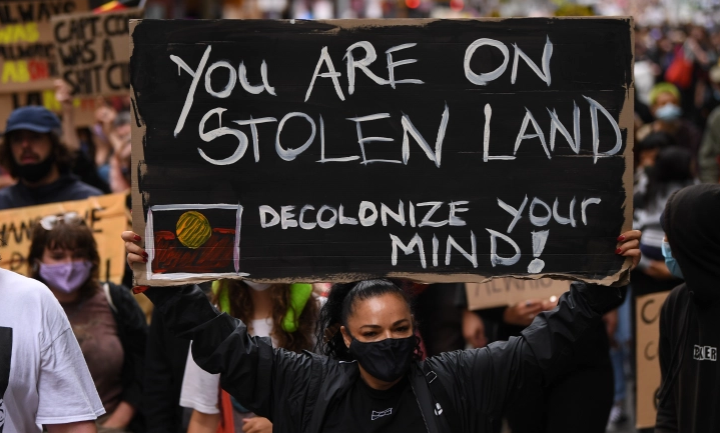
In Australia the past is no longer preserved as objective history. History is curated, weaponised, and rewritten by those who claim the mantle of historical justice. Nowhere is this more starkly embodied than in the Yoorrook Justice Commission in Victoria, where selective memory is elevated to moral authority, and ideological narrative replaces evidentiary truth.
Through the selective telling of history, institutions have been captured, dissent vilified, and national identity reprogrammed to serve a powerful ideological elite. This is not reconciliation but rather the triumph of narrative over fact, myth over memory, and identity over truth.
The contemporary discourse around Aboriginal history and identity is dominated by a small but powerful alliance of activists, academics, legal bodies, and publicly funded cultural institutions. This alliance has created a monopoly on historical narrative by:
♦ Reframing British colonisation as genocidal invasion
♦ Elevating tribal cultures as peaceful, ecological utopias;
♦ Vilifying any contrary evidence—such as inter-tribal violence, ritual abuse, systemic cultural abuse of women, sexual servitude, or cultural collapse—as racist.
♦ Enshrining grievance as the primary moral currency in national life.
Public broadcasters, museums, school curricula, universities, and judicial bodies now enforce a single vision of the Aboriginal past, one in which colonisation is the original sin, and Aboriginality is the sanctified victimhood that redeems. Any opposition to this narrative, however factual or well-sourced, is condemned as racism or denialism. This is Orwellian control of the present: the ability to rewrite the past, not through evidence, but by punishing dissent.
By dominating the historical narrative, this activist class retroactively rewrites the moral foundation of the nation. They erase inconvenient truths: that Aboriginal society was brutally patriarchal, that inter-tribal warfare was endemic, and that colonisation, though disruptive, brought medicine, literacy, legal equality, and often sanctuary from the violence of custom. Instead, history is flattened into a twoi-dimensional morality tale: put simply colonisers evil, colonised innocent.
This revisionism is not the outcome of scholarly debate, but of ideological coercion and narrative extortion, designed to erase dissent and punish deviation from the approved script. Academic freedom has been supplanted by ideological conformity, where loyalty to the dominant narrative outweighs evidence or critical inquiry. Academics who dissent are marginalised, silenced, or removed altogether. Museums quietly strip exhibits deemed “offensive,” even when the offence is contrived and manufactured purely to ensure that every display reinforces a narrative of colonial brutality. Schoolchildren are taught that terra nulliuswas an official doctrine, that “Country” is a legal subject, and that Aboriginal culture has remained unchanged for 50,000 years, an anthropological and scientific absurdity.
No figure better illustrates the cost of dissent in modern Australia than Geoffrey Blainey, who was vilified and marginalised for challenging the emerging orthodoxy surrounding Aboriginal history. Blainey questioned the scale and nature of frontier violence, warned against the politicisation of history, and cautioned that narratives were becoming detached from evidence. For this, he was relentlessly attacked by the academic establishment, forced from university appointments, and cast as a pariah, not for falsehood, but for refusing to conform. His real offence was not historical error, but ideological disobedience. In true Orwellian fashion, truth became heresy the moment it conflicted with the sanctioned myth.
Like Blainey, Keith Windschuttle became a lightning rod for outrage when he exposed serious flaws, exaggerations, and outright fabrications in the dominant narrative of frontier violence. In The Fabrication of Aboriginal History, he challenged the so-called “massacre map” and revealed how footnotes had been manipulated, sources distorted, and oral traditions uncritically elevated to fact. His method was rigorous, his tone restrained and yet the response was pure ideological fury.
Rather than engage with his evidence, the academic establishment launched a coordinated counterattack. A total of 17 historians published a book-length rebuttal titled Whitewash, not to correct the record, but to smear Windschuttle’s reputation and reaffirm the sanctity of the victim narrative.
Like Blainey, Windschuttle’s real offence was to expose politically useful myths to the light of documented truth, an unforgivable act in an age where history is no longer what happened, but what must be believed. In today’s institutions, tenured historians do not stray from the sanctioned path. To do so is academic suicide.
Few scholars now concern themselves with the truth of the past. Most are either silent, sidelined, or complicit. No politicians dare challenge the fallacious reinvention of our national story for fear of being branded racist, and no government-funded institution is willing to defend the historical record against ideological capture. The result is total submission. The Blaktivists have seized our historiography without resistance—and in doing so, they control the future.
The erasure of historical truth is no longer a future threat. It is already entrenched. In Victoria, for example, Registered Aboriginal Parties (RAPs) now exercise legal control over access to colonial records under the Aboriginal Heritage Act 2006. Researchers seeking to examine materials related to Aboriginal groups, land, or conflict must first obtain permission from these bodies, effectively placing the historical record under ideological gatekeeping. Similar access restrictions, though less formalised, are emerging in Western Australia, Queensland, and New South Wales, where archival material is increasingly filtered through the lens of cultural sensitivity. This is not preservation, it is censorship. The past is being sealed off, redacted, and rewritten under the guise of respect. As Orwell warned, “Who controls the past controls the future: who controls the present controls the past.” That control has already begun.
The prize of controlling history is not remembrance but power. By embedding victimhood into national memory, Aboriginal activism justifies:
♦ Permanent land claims through native title;
♦ Racially exclusive institutions (e.g. the First Peoples’ Assembly);
♦ Special legal status, reparations, and sovereignty claims;
♦ The right to speak on behalf of the nation while excluding those who question their authority.
The goal is not justice but jurisdiction. Through control of historical narrative, Aboriginal-identifying elites assert not merely moral superiority but constitutional privilege. Their vision is one in which identity, not citizenship, becomes the organising principle of Australian democracy.
Orwell’s prophecy is fulfilled: the past has been reconstructed to seize the future.
The concept of doublethink, also coined by George Orwell in 1984, finds chilling relevance today but not in the slogans of an authoritarian party, but in the rhetorical gymnastics of modern activism. Among so-called Blaktivists, doublethink is not merely an accidental contradiction but a required posture. It enables the holding of mutually exclusive beliefs: that Aboriginal people are simultaneously the most marginalised and the most spiritually advanced; that their culture is both fragile and indestructible; that colonisation destroyed everything, yet nothing has changed for 50,000 years.
Doublethink allows modern activists to condemn Western institutions as racist, oppressive, and illegitimate while simultaneously demanding the full benefit of their protections, resources, and legal privileges. The legal system is denounced as structurally unjust, yet invoked to secure race-based recognition, compensation, and land rights. Meanwhile, traditional Aboriginal culture is exalted as sacred, immutable, and spiritually superior while any documented evidence of violence, misogyny, or cultural collapse is dismissed as colonial slander.
This selective sanctification depends on wilful blindness to the historical facts and reality. It requires that history be edited, that moral complexity be denied, and that Aboriginal cultural atrocities be erased. Yet the historical record of many pre-contact Aboriginal societies is unequivocal. What follows are practices once widely acknowledged soon to be purged from public memory in the name of reconciliation, and replaced by myth:
Clan-based warfare: Far from peaceful harmony, inter-tribal life involved constant violence, ambushes, and territorial conflict, often carried out to extinction. Raids and retributive massacres were a norm, not an exception.
Absolute patriarchal control: Clans were ruled as rigid gerontocracies, with elder males exercising unchecked power over women, children, and younger men. Obedience was enforced by violence, exile, or death.
Brutal male initiation: Boys were subjected to violent initiation rites including circumcision, subincision (splitting of the penis), scarification, and beatings to enforce submission and group identity under threat of expulsion.
Chattel sexual enslavement of girls: By any modern definition of slavery, the bestowal of young girls to much older men, often as part of inter-clan peace arrangements, political alliances, or ritual obligations and constituted lifelong chattel sexual enslavement. These girls had no agency, no right of refusal, and no possibility of escape. Once bestowed, they became the property of the elder male, subject to sexual use, domestic labour, physical punishment, and total subjugation under threat of violence or death.
Ritualised gang rape (female initiation): So-called “initiation” into womanhood in many clans involved group sexual acts by elders, normalised as customary rites rather than condemned as sexual abuse.
Cannibalism: The practice of cannibalism was documented across multiple regions including endocannibalism, where deceased kin were ceremonially consumed, and exocannibalism, the consumption of defeated enemies as part of ritual warfare.
Infanticide: Newborns were routinely killed for reasons ranging from birth defects, twin births, gender preference, to the mother’s inability to support multiple children, a custom driven by subsistence logic but profoundly at odds with modern morality.
Senicide: Elderly clan members, once deemed a burden or unproductive, were sometimes abandoned or ritually killed, viewed not as cruelty but as practical population control.
Ritual mutilation of corpses: Bodies of the dead, especially enemies, were sometimes mutilated, dismembered, or kept in parts (skulls, hands) for ritual, revenge, or magical purposes.
Total absence of science and mathematics: There were no systems of formal logic, mathematics, astronomy (beyond anecdotal star lore), or abstract reasoning. All knowledge was localised, memorised, and ritualised — transmitted by oral tradition with no generalised scientific method.
Environmental ignorance beyond territory: “Traditional knowledge” was confined to narrow ecological zones. Movement beyond these areas often led to death, as there was no transferable science or navigational system only memorised, clan-specific lore.
Technological stagnation: For over 50,000 years, there was almost no technological innovation. The stone tool kit remained largely unchanged, fire was used but never mastered to create pottery or metallurgy, and the wheel was unknown.
No written language: All cultural knowledge was dependent on oral transmission, leaving it vulnerable to collapse with generational loss and making myth indistinguishable from history.
Rule of superstition and fear: Daily life was dominated by animistic beliefs and supernatural terror. Misfortune, illness, or death were rarely seen as natural events but were attributed to sorcery or spiritual punishment. The pointing of the bone—a death curse believed to kill through psychological suggestion—instilled paralyzing fear, often resulting in real physical decline or death through trauma and stress alone. This ritualised terror was not metaphorical; it controlled behaviour, enforced obedience, and suppressed dissent.
Witchdoctors and the tyranny of the Dreamtime: Tribal shamans or “clever men” acted as witchdoctors who dictated the rhythm of life through threats, omens, and spirit manipulation. Their authority was drawn not from empirical knowledge but from claims of access to invisible Dreamtime spirits—whose intentions were unquestionable and whose wrath was used to justify violence, exile, or death. Rather than a moral or spiritual guide, the Dreamtime functioned as a supernatural regime of control rooted in myth, fear, and fabricated authority.
Alcohol and cultural collapse: The introduction of alcohol precipitated one of the most rapid and universal social collapses in human history. Across nearly all regions, Aboriginal communities descended into cycles of addiction, violence, infertility, and dysfunction. Traditional structures already strained by disease, dispossession, and internal violence collapsed entirely under the corrosive influence of alcohol. Male authority degenerated into abusive dependency; women were prostituted for drink; children were neglected or abandoned; and clans became scattered remnants, reliant on settler rations and government charity. This was not cultural adaptation but rather cultural disintegration.
Such practices, well-documented in ethnographic records and early settler accounts, are either excused, denied, or erased entirely to preserve a myth of moral innocence. The very mention of these realities is now taboo, and their discussion framed as a racist affront rather than an anthropological fact. To observe these contradictions is to commit a social crime; to challenge them is to be denounced as racist. Thus, modern ideological doublethink like Orwell’s original vision functions not to describe reality, but to enforce obedience through distortion. It protects a political mythology by suppressing memory, evidence, and reason itself.
Where doublethink governs thought, ritual governs belief. Nowhere is this more visible than in the compulsory recitation of Welcome to Country ceremonies. These incantations are not neutral acts of respect; rather, they are ideological affirmations that all Australians “live, work, and play on Aboriginal land.” This formulaic declaration, embedded in classrooms, government meetings, sporting events, and corporate emails, requires the speaker to ritually affirm a political fiction: that Aboriginal sovereignty persists unbroken, and that all non-Indigenous presence is illegitimate.
Another ubiquitous mantra, “Always was, always will be Aboriginal land,” performs the same ideological function. It is not a statement of law, nor history, nor even belief. It is an act of political liturgy. It erases the entirety of post-1788 history, denies legal sovereignty, and asserts a timeless racial ownership immune to evidence, change, or challenge. It demands emotional assent rather than rational analysis, and like all slogans, it substitutes repetition for reasoning. Its power lies not in truth, but in ubiquity—and in the social cost of refusal.
This is not history; it is indoctrination. The repetition of such mantras reinforces a manufactured mythology of eternal ownership, spiritual supremacy, and moral entitlement. It bypasses critical thought and conditions children and adults alike into accepting guilt, dispossession, and historical distortion as self-evident truths. The function is not to acknowledge, but to assert dominance and to replace shared citizenship with inherited grievance, and to make ideological submission a civic obligation. In Orwellian terms, it is less freedom of thought than compelled belief, cloaked in the language of reconciliation.
Awhole nation is being taught to hate its own origins, to apologise for its foundations, and to question the legitimacy of its modern institutions. This is the true genius of the Blaktivists and their minions: a national identity that dismantles itself from within, while praising those who rewrite it.
Reconciliation was the opening move in a broader ideological offensive, a Trojan horse attacking the nation through doublespeak and historical obfuscation. Emerging in the 1990s under the guise of national healing, it quickly became a government-funded ideological front, designed not merely to acknowledge the past, but to invade the intellectual and historical heart of the nation.
Reconciliation and recognition has metastasized into a campaign of historical distortion, legal re-engineering, and cultural submission, now expanding unchecked and unchallenged. It is a relentless, escalating takeover of the national consciousness, waged not with weapons, but with classic Orwellian tactics: the control of thought, the policing of language, and the systematic elimination of truth from the historical narrative.
At its core lies a system of compelled doublethink, where Australians are expected to believe that the past is unknowable and irretrievable, and yet also accept that it is the world’s oldest continuous culture. That Aboriginality is both erased and eternal, both powerless and sovereign, both destroyed and morally supreme. Like an ideological cancer, it spreads through truth, law, and identity rewriting the past to command the future.
Now, with these words set down, I fear I will be marked for “forgetting”, another voice scrubbed from the official memory.
Robert Hill is a former Federal Police officer with a deep interest in Australian history and a serious concern about its ongoing misrepresentation