
The Continuing Crisis in Ceuta: “They Have to Go Away”
The invading soldiers of allah can’t be repatriated. The media refers to “youths” being “stranded” in the enclave:
Around half are reportedly unaccompanied minors.
Minister Sira Rego said Spanish law grants underage migrants fundamental protections regardless of their origin or legal status. She said the vast majority have asked to remain in Spain.
“Most of them want to stay in Spain and they are going to stay, of course. There is a law that protects them,” Rego told Spanish radio network Cadena SER.
“Our duty is to protect them,” she said.
Can you imagine? Their duty is to ‘protect’ the invaders, not their own people.

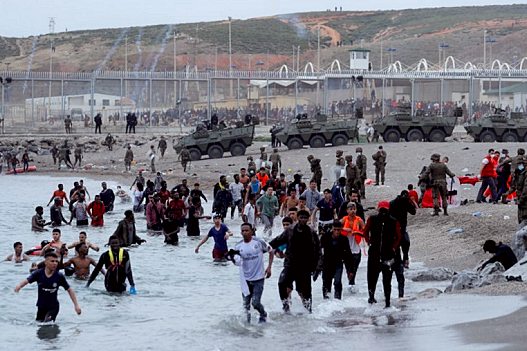
At the end of July a mob of mostly military-age young men invaded the Spanish enclave of Ceuta on the coast of North Africa. Ceuta is made up of a single city situated on a peninsula that juts out from Morocco into the Mediterranean. The invaders swam around the sea barriers and broke through parts of the fence to gain access to Spanish territory, with hopes of being able to cross the sea to the European continent.
There are some indications that the invasion was enabled and coordinated by Moroccan authorities. Most of the invaders were not Moroccans, but from further south in Africa, or from other parts of the Middle East.

An estimated 70,000 to 80,000 “migrants” entered Ceuta. The Spanish government said that most of them have returned to Morocco, but somewhere between 10,000 and 20,000 are thought to have remained in Ceuta, residing in shantytowns on the beach, or camping out in parks and empty buildings. Crime has become rampant, and sexual assaults against women have risen dramatically. Most of the rape victims are from the unfortunate minority of female migrants among the invaders, but a significant number of local Spanish women and girls have also been attacked.
Ordinary citizens in Ceuta are fed up with the situation. Yesterday they staged a mass march against the invasion, demanding that the foreigners be sent home. They volubly insisted that Ceuta is and will remain Spanish.

Below is a video from Al Jazeera about yesterday’s mass march in Ceuta against the invaders. Notice that one of the destitute migrants being interviewed has braces on his teeth:
A transcript of the video is included at the bottom of this post.
You’ll also notice how well one of interviewed invaders has absorbed the media Narrative on migration, and then regurgitated it to the interviewer. A sample:
It’s better for everyone if we try to understand each other. There are good people here who treat us well, but there are others who look down on us. There is racism and they treat you with contempt.
According to the Al Jazeera report, the rumored resumption of the invasion is misinformation. The Times, however, seems to disagree:
Ceuta braces for new migrant surge during Moroccan elections
Ceuta is bracing for a possible new mass crossing on Wednesday after calls spread on social media for migrants to enter the city on the same day that elections are being held in Morocco.
Tensions in the Spanish city in north Africa are rising and thousands of Ceutis marched in protest to the border with Morocco on Sunday. A sea barrier that was erected after the mass influx of migrants in July has broken apart, and doctors and nurses are preparing to strike.
José Manuel Albares, the Spanish foreign minister, said that Madrid had activated channels to counter calls circulating in Morocco for a new crossing. The interior minister, Fernando Grande-Marlaska, is visiting Ceuta on Monday.
About 80,000 people entered Ceuta irregularly during the crisis that began on July 30. The government has been unable to provide reliable figures, but estimates about how many remain in Ceuta, which has a regular population of 83,000, range between 10,000 and 15,000.
The 500-metre inflatable barrier, erected at the Tarajal breakwater on Ceuta’s border with the Moroccan city of Castillejos where the July invasion occurred, has broken apart. The barrier was intended to provide the physical line needed to deal with a legal problem exposed by a Supreme Court ruling shortly before the July influx.
A court had ruled that Spain’s procedure for immediately rejecting migrants at the frontier could not simply be applied to people intercepted after entering by sea. The floating barrier is supposed to define a physical border.
At Sunday’s demonstration, Ceutis chanted “expel the invaders”. There is a growing sense among residents that the city has surpassed its limits to cope with the numbers of migrants on its streets and beaches. Trampolin beach, which was cleared for a second time amid a stampede last week, has been fully occupied once more by a makeshift village of shelters.
This latest invasion is similar to the Great Migration Crisis of 2015, when hundreds of thousands of illegal immigrants entered Western Europe, especially Germany. Because minors get special treatment and are difficult to deport, thousands of young men who had discarded their IDs claimed to be children. The number of swarthy 17-year-olds with heavy five o’clock shadow was astonishing.
The same thing has now happened in Ceuta. And — surprise! — the poor wee bairns can’t be repatriated. The article refers to the “youths” as being “stranded” in the enclave:
Spain’s youth minister said Monday that most unaccompanied minors stranded in Ceuta after a mass border breach in July will remain in Spain, despite an earlier pledge by the Spanish government to return those who entered illegally to Morocco.
In July, more than 80,000 people crossed into the Spanish enclave in what authorities described as an unprecedented border breach. Between 5,000 and 10,000 people, depending on figures from the different authorities, are believed to have remained in Ceuta as Madrid works to identify them and arrange their return to Morocco.
Around half are reportedly unaccompanied minors.
Minister Sira Rego said Spanish law grants underage migrants fundamental protections regardless of their origin or legal status. She said the vast majority have asked to remain in Spain.
“Most of them want to stay in Spain and they are going to stay, of course. There is a law that protects them,” Rego told Spanish radio network Cadena SER.
“Our duty is to protect them,” she said.
El Constitucional reports on the response from the anti-immigration party Vox: