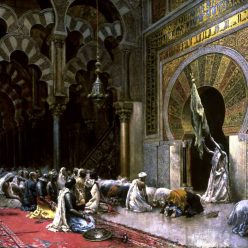
“Arabs are the most noble people in lineage, the most prominent, and the best in deeds…”
by Hugh Fitzgerald

One of the favorite themes of apologists for Islam is that the faith is open to people of all races and ethnicities, and that they are, within the umma, treated equally. The figure of Bilal, an Ethiopian born in 580 A.D., who became a slave in Mecca and then, after his conversion to Islam, was set free, is central to this narrative. For Bilal was not only one of the Companions of the Prophet, but was the very first muezzin, calling Muslims to prayer with his deep, melodious voice.
The story, as told by Fawaz Turki in the Gulf News, is HERE:
“Adhan, the call summoning the faithful to prayer, delivered by a muezzin, has rang [sic] out from atop the minarets of mosques around the world for the last 15 centuries, ever since the Islamic commonwealth of nations began in the seventh century to spread its wings to the West and East — where, indeed, the twain did actually meet, and meet in a communal sense of reference and devout compliance to [sic] a shared faith.
Comment:
It is inaccurate to describe the peoples and lands conquered by the forces of Islam as a “commonwealth of nations,” an anachronism that does not adequately describe the Islamic state in which conquered nations are not joined as equals in a “commonwealth” but subsumed in a caliphate.


















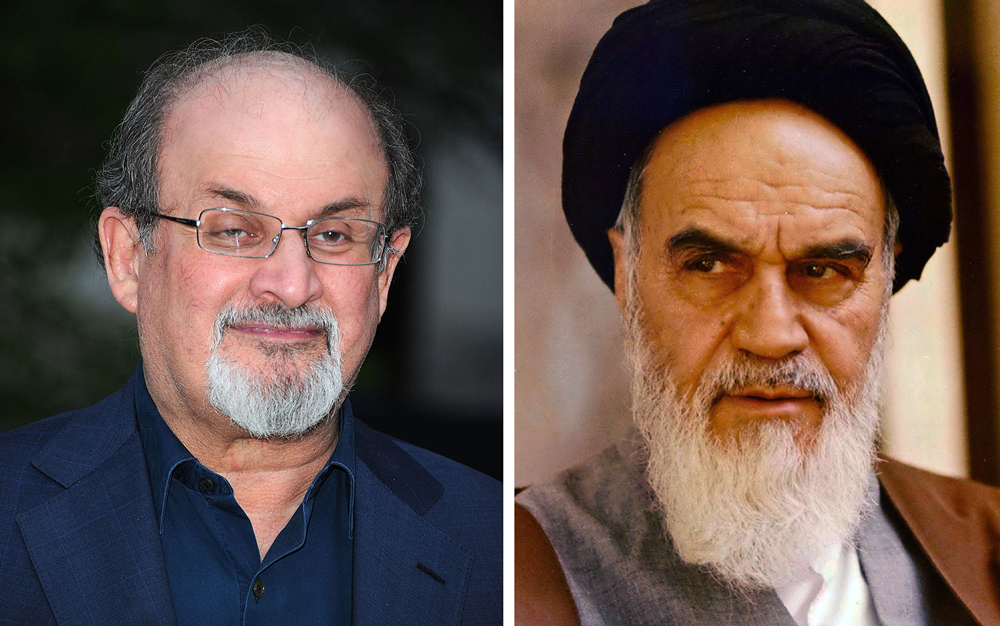 In 1988, The Satanic Verses was published, written by Salman Rushdie (left), a British citizen. Iran’s “Supreme Leader” Ayatollah Ruhollah Khomeini (right) in 1989 condemned Rushdie to death for writing the book. The Rushdie affair seems to have deeply shaped British society. (Image sources: Rushdie – Andrew H. Walker/Getty Images; Khomeini – Mohammad Sayyad/Wikimedia Commons)