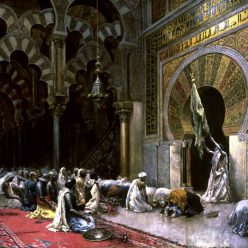

Today in history, May 18, 1565, one of the most symbolically important military encounters between Islam and Europe began: the Ottoman Turks besieged the tiny island of Malta, in what was then considered the heaviest bombardment any locale had been subjected to.
Around the start of the sixteenth century, Muslim pirates from Algiers began to terrorize the Christian Mediterranean. Like their terrestrial counterparts, they too were indoctrinated in and emboldened by Muhammad’s promises: “A campaign by sea is like ten campaigns by land,” the prophet had said, “and he who loses his bearings at sea is like one who sheds his blood in the path of Allah”—that is, he is rewarded either in the here or hereafter. The piratical lust for booty was, accordingly, heightened by dreams of “martyrdom.”
When Suleiman “the Magnificent”—better known among Muslims as Suleiman “the Ghazi” (jihadi/raider)—became Ottoman sultan in 1520, he instantly took the most notorious of these Barbary pirates, Khair al-Din Barbarossa, into his service and helped him prosecute the sea jihad on Europe. The ensuing reign of terror forced Europeans along the Mediterranean coast to relive the days of their ancestors in the centuries before the Crusades, when the Middle Sea was first inundated with jihad and slave raiding. Over the following two decades, hundreds of thousands of Europeans were enslaved, so that, by 1541, “Algiers teemed with Christian captives, and it became a common saying that a Christian slave was scarce a fair barter for an onion.” Continue reading The “Image of Hell”: Islam’s Siege of Malta


 In the days following the attack on Dasht-e-Barchi hospital in Kabul, Afghanistan, it has become clear that what happened on 12 May was a deliberate assault on a maternity hospital with the purpose of killing mothers in cold blood. “I went back


 EU Home Affairs Commissioner: Europe must go ‘back to the future’ of open borders after coronavirus is under control


An international poll of more than 6,000 doctors released Thursday found that the antimalarial drug hydroxychloroquine was the most highly rated treatment for the novel coronavirus.
Continue reading Hydroxychloroquine rated ‘most effective therapy’ by doctors for coronavirus: Global survey