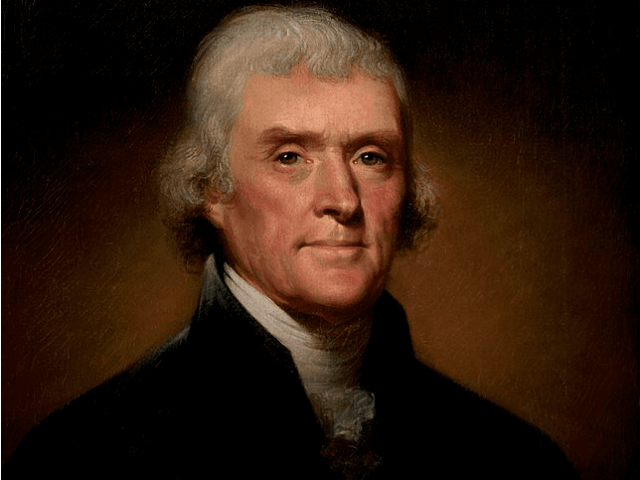
Jefferson had a very dim view of Islam, which came out of his experience in dealing with the Barbary Pirates, that is, the North African Muslims (in Morocco, Algiers, Tunis, and Tripoli), who attacked Christian shipping and seized ships and Christian sailors, and then demanded ransom. The sums were not trivial; the American Republic found itself spending 20% of its national budget on such payments. These continued until Jefferson became President, stopped the practice of paying such tribute, and instead made war on the Barbary Pirates. And that worked.
Hugh Fitzgerald: No Room at the Inn for an Iftar Dinner

The Washington Post has reported — drop a ready tear — that there will be no Iftar Dinner this year in the White House:
For the first time in nearly two decades, Ramadan has come and gone without the White House recognizing it with an iftar or Eid celebration, as had taken place each year under the Clinton, Bush and Obama administrations.
And the article by Amy Wang attempts to suggest that the “tradition” of the Iftar Dinner goes all the way back to Thomas Jefferson who, as is well known, was asked by a visiting Muslim envoy of the Bey of Tunis, one Sidi Soliman Mellimelli, to postpone the dinner to which Jefferson had invited him, along with others, until after sundown, which Jefferson, as a matter of courtesy, did.
The Post continues:
Jefferson’s decision to change the time of the meal to accommodate Mellimelli’s [the envoy from the Bey of Tunis] observance of Ramadan has been seized on by both sides in the 21st-century debate over Islam more than 200 years later. Historians have cited the meal as the first time an iftar took place in the White House — and it has been referenced in recent White House celebrations of Ramadan as an embodiment of the Founding Father’s respect for religious freedom. Meanwhile, critics on the far right have taken issue with the characterization of Jefferson’s Dec. 9, 1805, dinner as an iftar.
Notice how in the Post article it is “historians” (disinterested, authoritative, not to be doubted) who cite that 1805 meal as the first Iftar dinner in the White House, while those who deny that the meal was an “Iftar dinner” are described as being on the “far right,” apparently for no other reason than that very denial.
What actually happened is clear for those without an insensate need to make Islam, as Barack Obama has repeatedly claimed it was, “always part of America’s story.” And you can be as left-wing as all get out, and still recognize that Jefferson was not putting on an Iftar dinner. A little history will help: Mellimelli came to Washington as the envoy of the Bey of Tunis. The Americans had blockaded the port of Tunis, in order to force the Bey to halt his attacks on American shipping. Mellimelli was sent to make an agreement that would end the blockade. Invited by Jefferson to a dinner at the White House set for 3:30 (dinners were earlier in those pre-Edison days of our existence), he requested that it be held after sundown, in accordance with his Muslim practice, and Jefferson, a courteous man, obliged him. There is no hint that the dinner had changed in any way; no one then called it, or thought of it, as an “Iftar dinner.” Mellimelli himself did not describe it as an “Iftar dinner.” There is no record of it being anything other than the exact same dinner, the same menu, with wine (no removal of alcohol as would be necessary were it a real Iftar dinner), the only change being that of the three-hour delay until sunset. Nothing Jefferson said or did at the time, or in his later writings, indicates that he thought of that delayed dinner as an “Iftar dinner”; nor did he think he was in any way honoring Islam.
Continue reading No, Jefferson did not hold an “iftar dinner”- he made war on the Barbary Pirates