
According to most of the world’s media, an unfathomable tragedy has been slowly unfolding in Myanmar. The Buddhist majority, inflamed by sinister monks, has been persecuting, killing, even massacring, members of the entirely inoffensive Muslim Rohingya minority in the northern state of Rakhine (formerly, and in some places still, known as “Arakan”). The term “Rohingya” refers, as Professor Andrew Selth of Griffith University has noted, to the “Bengali Muslims who live in Arakan State…most Rohingyas arrived with the British colonialists in the 19th and 20th centuries.” Some call the attacks a “genocide.”
According to almost all reports from non-Burmese, these attacks on the Rohingya are completely indefensible and, indeed, inexplicable, the result of hysteria – assumed by one and all to be without any conceivable justification –whipped up by Buddhist monks, headed by a sinister senior monk, Ashin Parathu, who has been accused by The Guardian of “stoking religious hatred across Burma. His paranoia and fear, muddled with racist stereotypes and unfounded rumors, have helped to incite violence and spread disinformation.”
Particularly disappointing for many reporters has been what they regard as the unforgivable silence of Aung San Suu Kyi, currently the head of the Myanmar government. For Aung San Suu Kyi was formerly the leader of the nonviolent opposition to the Burmese military, placed under house arrest by the generals, then freed and awarded a Nobel Peace Prize in 1991. For more than two decades she was, for her continued defiance of the generals, and willingness to endure that house arrest, a darling of the international media. She has held a number of important government posts and is now both Foreign Minister and State Counsellor (equivalent to Prime Minister) in Myanmar.
But in her continuing refusal to condemn outright the attacks on the Rohingya, and in her insistence that in Myanmar there has been “violence on both sides,” Aung San Suu Kyi is now seen by many outside Myanmar in quite another light. Many have criticized Aung San Suu Kyi for her silence on the 2012 Rakhine State riots, when Buddhists attacked Muslims, and castigate her for what they see as her general indifference to the ongoing mistreatment of the Rohingya by Burmese Buddhists. Twenty-three Nobel laureates and other “peace activists” signed a letter in November 2016 asking Aung San Suu Kyi to speak out about the Rohingya: “Despite repeated appeals to Daw Aung San Suu Kyi, we are frustrated that she has not taken any initiative to ensure full and equal citizenship rights of the Rohingyas,” their Open Letter states. “Daw Suu Kyi is the leader and is the one with the primary responsibility to lead, and lead with courage, humanity and compassion.” Continue reading Hugh Fitzgerald: The Rohingyas, Aung San Suu Kyi, and the Maligning of Myanmar
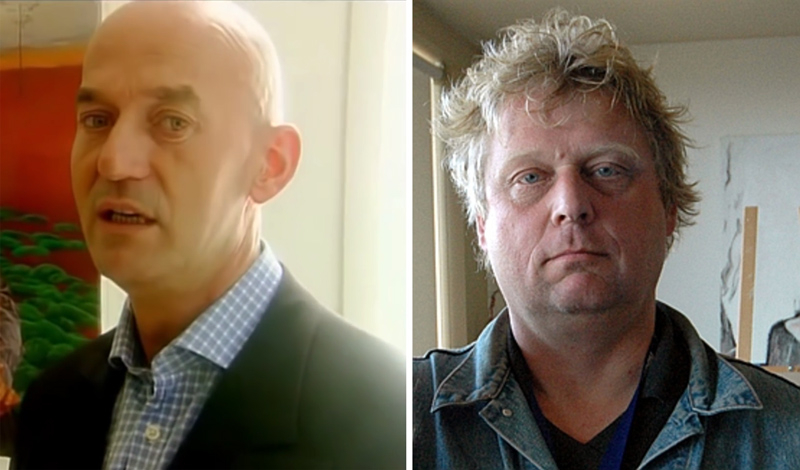 The Netherlands has already had two political assassinations related to Islam: the politician Pim Fortuyn (left), and Theo van Gogh (right), a filmmaker. (Image sources: Van Gogh – Wikimedia Commons; Fortuyn – Forza! Nederland video screenshot)


 I suppose the authorities are still unclear about his motive – they usually are even when it is glaringly obvious. From Sky News again Police confirm a crime watchlist suspect shot a policewoman before launching an attack on a soldier at a Paris airport. A radicalised Muslim on a crime watchlist