By Daniel Pipes

After Hitler, the policy of appeasing dictators – ridiculed by Winston Churchill as feeding a crocodile, hoping it will eat one last – appeared to be permanently discredited. Yet the policy has enjoyed some successes and remains a live temptation today in dealing with the Islamic Republic of Iran.
Academics have long challenged the facile vilification of appeasement. Already in 1961, A.J.P. Taylor of Oxford justified Neville Chamberlain’s efforts, while Christopher Layne of Texas A&M currently argues that Chamberlain “did the best that he could with the cards he was dealt.” Daniel Treisman, a political scientist at UCLA, finds the common presumption against appeasement to be “far too strong,” while his University of Florida colleague Ralph B.A. Dimuccio calls it “simplistic.”
* This website  does not promote appeasement. A closer look at who the appeasers are  is quite revealing: a host of corrupt, deluded or corrupt ex-government stooges who team up with Islamic propagandists like Ingrid Mattson. Their activities are nothing short of treason./edÂ
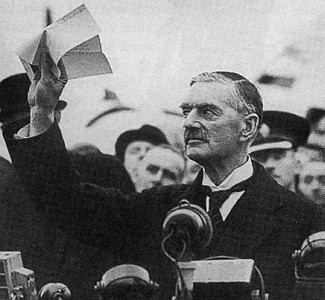 Neville Chamberlain mistakenly declared “peace in our time” on September 30, 1938. Neville Chamberlain mistakenly declared “peace in our time” on September 30, 1938. |
In perhaps the most convincing treatment of the pro-appeasement thesis, Paul M. Kennedy, a British historian teaching at Yale University, established that appeasement has a long and credible history. In his 1976 article, “The Tradition of Appeasement in British Foreign  Policy, 1865-1939,” Kennedy defined appeasement as a method of settling quarrels “by admitting and satisfying grievances through rational negotiation and compromise,” thereby avoiding the horrors of warfare. It is, he noted, an optimistic approach, presuming humans to be reasonable and peaceful.
Â
From the prime ministry of William Gladstone until its discrediting in the late 1930s, appeasement was, in Kennedy’s description, a “perfectly respectable” term and even “a particularly British form of diplomacy” well suited to the country’s character and circumstances. Kennedy found the policy had four quasi-permanent bases, all of which apply especially well to the United States today:
Continue reading "Peace In Our time" Means Appease Iran?