Little girl in Indonesia after having clitoris removed (30 years ago almost unheard of, now common, thanks to Islam….)

The Baron from the Gates of Vienna did his own research and came up with this:
To Cut or Not to Cut?
Last night, when writing about the Algerian mufti and his reaction to proposed restrictions on wife-beating, I mentioned in passing that female genital mutilation enjoys scriptural validation under Islam. In the comments, Anti-Islamist asked for a specific citation to support my assertion:
…i humbly must ask the Baron: where in the Koran or the Hadiths are these nicities imposed?
I should be very much obliged to you for giving me an exhaustiv answer. Thank you!
By then it was quite late, and I was too tired to do more than make a quick search. As a result I listed only a weak hadith from Abu Dawud about female circumcision in my response.
However, it’s important to remember that although Islamic law relies on the Koran and the hadith for its ultimate authority, there are other sources of authoritative instruction under the fiqh (Islamic jurisprudence). The actual details of sharia are codified in the four major schools of Islamic law (Hanafi, Maliki, Shafi, and Hanbali). The Reliance of the Traveller (’Umdat al-Salik), by Ahmad ibn Naqib al-Misri, is a Shafiite law manual, and is considered one of the best and most reliable authorities on the specifics of sharia. As the documents in the preface to Nuh Ha Mim Keller’s translation attest, his version is recognized as an officially approved statement in English of the doctrines of Islamic law, as certified by Al-Azhar University and the governments of Saudi Arabia, Jordan, and Syria.
Unfortunately, a complete Reliance of the Traveller is all but impossible to find online. So today, after a good night’s sleep, I got out my copy of ’Umdat al-Salikand looked up the relevant section on circumcision.
Let’s see what Al-Misri has to say in Book E, “Purification”, Section e4.0, “The Body”:
– – -Â – – – – –
e4.3Â Â Â Â Â Circumcision is obligatory (O: for both men and women. For men it consists of removing the prepuce from the penis, and for women, removing the prepuce (Ar. bazr) of the clitoris (n: not the clitoris itself, as some mistakenly assert). (A: Hanbalis hold that circumcision of women is not obligatory but sunna, while Hanafis consider it a mere courtesy to the husband.)
There are four doctrinal schools of Sunni Islamic law: the Hanafi, the Maliki, the Shafi, and the Hanbali. In this passage al-Misri names all four schools.
Does he seem to name only two of schools? A closer inspection tells us more.
This is a Shafiite manual, and it explains Shafiite rules. It makes no exception for the Malikis, so the stated rule — circumcision is obligatory — applies to bothShafi and Maliki. The first exception is for the Hanbalis, who hold that circumcision of women is not obligatory, but recommended. And finally it acknowledges that the Hanafis consider it a mere courtesy to the husband.
So now what does this tell us? All of Sunni Islam says that female circumcision is a good thing. And two of those schools actually say it is mandatory.
As a side note, a contact who is a scholar of Arabic tells me that the Arabic version of this passage gives instructions to cut the whole thing out, and not just the prepuce — which confirms what most of us thought.
I hope this gives a more complete and comprehensive answer to the reader’s question.
Baron Bodissey didn’t  need to go through pains to do his own research: here on Winds of Jihad we have already done it a while ago, and came up with the same result……. Now look out for Mohammedan drones who will pop up and tell us that its got nothing to do with Islam, that it is cultural, that “other religions do it too”, especially the Hottentots and the one legged pygmies, even Eskimos do it and blah blah…. you know the drill.
You have arrived, Baron. Congrats!
The OIC took notice of you. You are a fearsome enemy of Islam. Hope you got a panic room…..
Baron Bodissey
I reported briefly yesterday on the sharia requirement for female circumcision, as mandated by Reliance of the Traveller, which is the authoritative law manual under the Shafiite school of Islamic law. In the comments section on the post, Inalienable Rights requested that I scan the page in question and post it so that everyone could have a look.
I’m more than happy to comply, but a first brief introduction is in order. We (that is, people who resist the Great Jihad) are routinely accused of distorting Islamic doctrine, quoting material out of context, relying on “extremist” sources that do not represent “true Islam”, etc. I’ll present the material here as if I were establishing an evidentiary chain in a court of law, citing factual material from creditable sources so as to present a case that could stand up before a judge and a jury.
But this process represents Western standards of logic and legality. None of it will stop me from being accused of “defaming Islam”, because anything I do — even quoting authoritative sources on Islamic law — is defined as “defamation” under sharia if it does not serve to further Islam.
That’s why the kuffar may be legitimately shouted down for quoting the Koran, while Muslims may do the same freely. This is not illogical, and there’s no contradiction: it makes complete sense, once you understand the basic premises of Islamic doctrine.
*Â Â Â *Â Â Â *Â Â Â *Â Â Â *Â Â Â *Â Â Â *Â Â Â *Â Â Â *Â Â Â *Â Â Â *Â Â Â *Â Â Â *Â Â Â *Â Â Â *
 The source I cite here is ’Umdat al-salik wa ’uddat al-nasik, or The reliance of the traveller and tools of the worshipper. It is commonly referred to as Reliance of the Traveller when cited in English.
According to the title page, my copy is the Revised Edition (published 1991, revised 1994) and is “The Classic Manual of Islamic Sacred Law ’Umdat al-Salik by Ahmad ibn Naqib al-Misri (d. 769/1368) in Arabic with Facing English Text, Commentary, and Appendices”, edited and translated by Nuh Ha Mim Keller. The publisher is listed as amana publications in Beltsville, Maryland.
Why do I consider this an authoritative source on Sunni Islamic law?
Because it is certified as such by Al-Azhar University in Cairo. There is no higher authority on Sunni Islamic doctrine than Al-Azhar; it is the closest equivalent to the Vatican that can be found in Islam.
On page xx of the “Documents” preface, we find this encomium (the Arabic version, including official stamps and seals, is on the facing page xxi):
– – -Â – – – – – –
[CERTIFICATION OF AL-AZHAR]
IN THE NAME OF ALLAH, MOST MERCIFUL AND COMPASSIONATE
al-Azhar
Islamic Research Academy
General Department for Research, Writing, and Translation
Mr. Nuh Ha Mim Keller
Amman, Jordan
Peace be upon you, and the mercy of Allah and His blessings.
To commence: In response to the request you have submitted concerning the examination of the English translation of the book ’Umdat al-salik wa ’uddat al-nasik by Ahmad ibn Naqib in the Shafi’i school of jurisprudence, together with appendices by Islamic scholars on matters of Islamic law, tenets of faith, and personal ethics and character: we certify that the above-mentioned translation corresponds to the Arabic original and conforms to the practice and faith of the orthodox Sunni Community (Ahl al-Sunna wa al-Jama’a). There is no objection to printing it and circulating it.
The stamping of the pages of the above-mentioned work with the seal of the department has been completed.
May Allah give you success in serving Sacred Knowledge and the religion. Peace be upon you, and the mercy of Allah and His blessings.
Composed on 26 Rajah 1411 A.H./11 February 1991 A.D.
General Director of Research, Writing, and Translation
Fath Allah Ya Sin Jazar [signed]
Muhammad ’Umar Muhammad ’Umar [signed]
Seal of al-Azhar [stamped] General Department for Research, Writing, and Translation
This establishes the unassailable credentials of Nuh Ha Mim Keller’s translation of ’Umdat al-Salik.
In Book E “Purification”, section e4.0 “The Body”, we find on page 59 the following text:
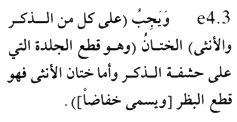
This is the original Arabic, for those of our readers who read the language and can translate it for themselves. For everyone else, below is an image of the English side-by-side with the Arabic. I include e4.4 just to give you an idea of the type of material covered by Book E:
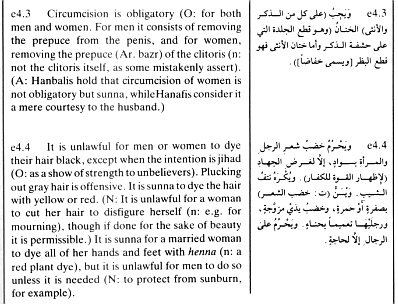
And here is the same text after it has been processed through the OCR:
e4.3 Circumcision is obligatory (O: for both men and women. For men it consists of removing the prepuce from the penis, and for women, removing the prepuce (Ar. bazr) of the clitoris (n: not the clitoris itself, as some mistakenly assert). (A: Hanbalis hold that circumcision of women is not obligatory but sunna, while Hanafis consider it a mere courtesy to the husband.)
As I mentioned yesterday, this section demonstrates that all four schools of Sunni law consider female circumcision a good thing, and two of them list it as mandatory.
I also mentioned that the original Arabic is more stringent than the English version, in that it specifies excising the entire clitoris rather than just the prepuce. I find further backing for this assertion in the Australian Islamist Monitor, which reports:
Reliance of the Traveller, a classical manual of Islamic sacred law in Arabic with facing English text, commentary and appendices edited and translated by Nuh Ha Mim Keller (1994) re ‘circumcision’ we find the Arabic actually says –
“Circumcision is obligatory (for every male and female) by cutting off the piece of skin on the glans of the penis of the male, but circumcision of the female is by cutting out the clitoris (this is called HufaaD). “ (p59) (Shafi’I jurisprudence)
(Note the English version is falsely translated as ‘prepuce ‘ of the clitoris!!)
The Arabic word bazr does not mean “prepuce of the clitoris”, it means the clitoris itself (cf. the entry in the Arabic-English Dictionary). The deceptive translation by Nuh Hah Mim Keller, made for Western consumption, obscures the Shafi’i law, given by ’Umdat al-Salik, that circumcision of girls by excision of the clitoris is mandatory. This particular form of female circumcision is widely practiced in Egypt, where the Shafi’i school of Sunni law is followed. Note a comment by Sheikh ‘Abd al-Wakil Durubi in the English ‘version’ notes “Hanbalis hold that circumcision of women is not obligatory but sunna, while Hanafis consider it a mere courtesy to the husband.” (answering-Islam.org)
This is supported by several hadiths eg
Abu-Dawud Book 41, No. 5251: Narrated Umm Atiyyah al-Ansariyyah: A woman used to perform circumcision in Medina. The prophet (peace be upon him) said to her: Do not cut severely as that is better for a woman and more desirable for a husband.
(Note: The powerful Mohammad did NOT stop the procedure yet he did stop the Arab practise of adoption when he wished to marry his adopted son’s wife Zainab, regarded as incest by the Arabs because adopted sons were held as sons!)
Anyone who reads Arabic is invited to check the image posted above against what AIM says here, and see if you agree with it.
With this, the sharia justification (and, under Shafi, requirement) for radical female circumcision is now clearly and fully demonstrated, and constitutes a “fact in evidence”.
Case closed.
Update:
Here’s an interesting discourse from the Sunni Forum:
Muslim:
Continue reading Clit-Cutting (FGM) "Obligatory" in Islam!