Nineteen Eighty-Four at 70: What Orwell Got Right
This summer, George Orwell’s novel Nineteen Eighty-Four turns 70 years old, and that anniversary has prompted a surfeit of articles analyzing the book and its continuing relevance to our age.
There is no doubt that the book is one of the most consequential political novels ever written and ought to be on the reading list of every conservative — not because Orwell was himself a conservative (he remained a man of the Left until his death), nor because the dystopian world that Orwell described turned out to be prophetic.
“The image of a boot stamping across the human face,” in Orwell’s memorable phrase, is an accurate depiction of present-day North Korea or China, but is not really an apt description of the U.S. or Western Europe, societies that have fallen into the kind of soft despotism described by Alexis de Tocqueville, but well short of the dystopian nightmare foreseen in Nineteen Eighty-Four.
However, the novel remains prescient in its depiction of two key elements of modern-day political correctness conceived of and promoted by the Progressive Left: the war on language and the war on memory.
In Nineteen Eighty-Four, Orwell focuses on an individual living in “Oceania,” a socialist society comprising the present-day nations of England and the Americas. In the novel, Oceania is abandoning standard English, which is referred to as “Oldspeak,” and is adopting “Newspeak,” a limited vocabulary designed to restrict thought.
Orwell understood that words enable thought and thought enables action. If there is no word for something, it makes it hard to think about it. This is an ancient insight — the Bible speaks reverently of “The Word.”
Orwell tells us that:
“It was intended that when Newspeak had been adopted once and for all and Oldspeak forgotten, a heretical thought… should be literally unthinkable, at least insofar as thought is dependent on words.”
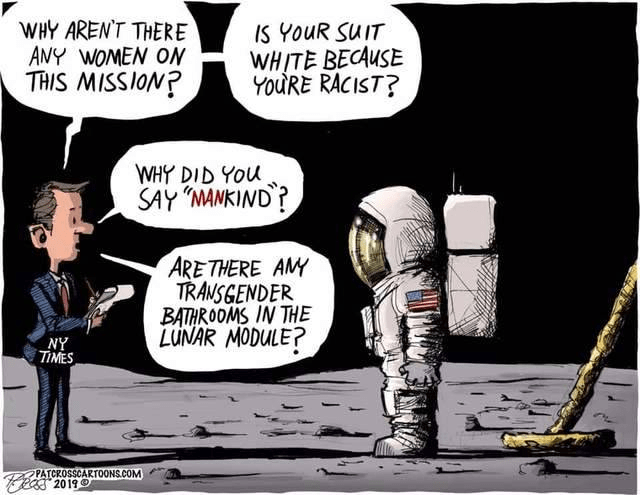
On the college campuses, the progressives have adopted a form of Newspeak with the identical goal — to get rid of heretical thoughts. Thus, students are protected by “safe spaces,” works of art that might cause discomfort are preceded by “trigger warnings,” and prohibited statements are referred to as “microagressions,” and “hate speech.” Make the latter phrase a compound word (hatespeech) and it has an unmistakably Orwellian cadence.
 Starting in academia, politically correct speech has now infected the media, the arts, tech companies, and corporations. Continue reading What Orwell Got Right